 Share This
 Contact Us
Technology Overview
Billions of devices across various industries remain unconnected. For the past twenty years, the wireless revolution has left device communication unchanged … until now. Ultra-Link Processing™ (ULP), from On-Ramp Wireless, is the groundbreaking innovation that delivers a wireless technology built from the ground up to support sensor and device communication. This end-to-end solution provides the optimal mix of coverage, capacity, low-power consumption, and cost, and fills a significant gap in the wireless technology landscape.
ULP is a half-duplex system, operating in a star topology and is deployed using industry standard and time-tested modeling tools, similar to those used in the mobile telephony industry. The system delivers the lowest cost of ownership in the industry and is simple to deploy, operate, and maintain.
The On-Ramp Wireless Advantage
The On-Ramp Wireless ULP system’s advantages are derived from our unique innovation that leverages the proven technology of Direct-Sequence Spread Spectrum (DSSS) modulation. The ULP technology is optimized from the ground up to solve critical issues in applications such as the Smart Grid, industrial condition monitoring, and asset tracking. Most other attempts at solving these problems are merely adaptations of related industry standards, leading to complex network infrastructures and high costs. There are numerous technical terms in the industry to explain networking solutions in complicated detail, however, the performance of wireless systems can be effectively summarized and objectively compared by simply looking at coverage, capacity, power consumption, coexistence and security.
Coverage
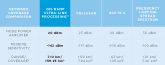
A radio’s ability to find weak signals over vast geographic areas in the face of high interference can be measured by receive sensitivity; an objective measure of the radio’s ability to demodulate a signal bounded by power levels. Receive sensitivity is the only way to accurately measure range and robustness of wireless systems in an apples-to-apples comparison. On-Ramp Wireless’ ability to achieve 40dB of additional receive sensitivity compared to other free spectrum radios, translates into a groundbreaking advantage in terms of both coverage and robustness. The following comparison is based on an Okumura-Hata propagation model, which is well accepted in the industry as an accurate predictive tool of coverage in various types of real-world environments.
The On-Ramp Advantage
Wireless Systems Metrics
Coverage
Extensive range in any environment
Capacity
If you cover a lot, you need to process a lot
Coexistence
Be a good neighbor
Power Consumption
Not everything is plugged to the wall
Security
End-to-end, verified security features
Network Coverage Table
Click to enlarge
Capacity
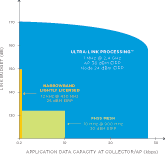
The ULP system has an immense uplink capacity. The capacity model is specifically designed to meet the requirements of the wide area collection of sensing data, through the use of an efficient access method. The system uses Random Phase Multiple Access (RPMA) – a unique access method developed by On-Ramp Wireless – to support thousands of simultaneous connections to a single Access Point (AP). RPMA, which is patented, has similarities to CDMA, however RPMA channelizes (i.e. uniquely identifies) devices through random phase offsets in a scrambling code rather than using separate codes.
The On-Ramp Wireless innovation of the RPMA receiver enables efficient demodulation of all possible phase hypotheses for all possible spreading factors to decode the messages. This requires significant amounts of computation, however through clever algorithms, the search space has been condensed to allow an implementation of the system in commodity hardware.
ULP has an extremely lightweight over-the-air (OTA) protocol, optimized for transmission of many small data packets from dispersed devices. This minimizes overhead and maximizes application throughput (i.e. goodput). Additionally, RPMA allows nodes operating under widely ranging link conditions to connect to the AP. A device with a very weak signal does not impede any other nodes in the network. It simply reverts to a higher level of processing gain and, in turn, consumes less of the overall available throughput.
ULP’s simple star topology makes it easy to manage congestion. This allows ULP to be operated with a lower margin than competing systems. For example communication in a wireless mesh environment, requires a large margin due to the inherent instability of the statistical random access methods used.
Ultimately, RPMA and the simple, but efficient, nature of the ULP system, delivers a system with enormous capacity - enough to process all the devices in the extensive coverage area.
Coexistence
Radios operating in unlicensed spectrum must address the issue of coexistence. ULP provides superior performance for the following coexistence requirements:
- Robustness to interference, as transmitters are regulated and the propagation environment is unpredictable and in constant flux.
- Ability to operate under strict and varying regulations.
- Not causing undue radio frequency interference.
The ULP physical layer is extremely robust to interference. The 39 dB of DSSS processing gain, inherent in the ULP physical layer, provides superior co-channel and adjacent channel rejection. This allows ULP to operate as a single frequency network, which minimizes the spectral footprint of the ULP system and enables multiple, non-coordinated ULP systems to exist in a given service area.
The system’s long symbol durations (4 milliseconds) allow for demodulation even with limitlessly strong burst interference. This robustness enables ULP to take advantage of elevated Access Point locations, such as mountain top antenna farms, mobile operator towers and tall buildings. Less robust technologies cannot use these types of sites due to the interference they receive from co-located transmitters and the surrounding areas. The ULP system uses these types of sites, which takes a nominal 600x coverage advantage due to link budget, and turns it into a 10,000x coverage advantage.
Power Consumption
ULP can connect continuously powered (electric meter, remote monitoring unit, etc.) and battery-powered (water/gas meters, fault circuit indicators, etc.) devices. The ULP protocol is extremely efficient, which optimizes performance for battery-powered devices. Depending on the data transmission requirements, the endpoint can be in a low power (deep sleep) mode most of the time. The endpoint is awake only for a short period of time in order to receive and transmit data. Endpoints transmit at the minimum processing gain required to close link, based on a locally calculated Received Signal Strength Indicator (RSSI) inferred from parameters received in the downlink portion of the frame cycle. The endpoints have a patented low power network acquisition algorithm, which saves power through maintaining tight time synchronization to the ULP network. Furthermore, ULP uses a simple star topology, as opposed to wireless mesh, and the ULP endpoints do not have to repeat traffic.
On-Ramp Wireless has developed extremely efficient ASIC hardware for the endpoint for battery-powered applications. Low duty cycle applications, such as water/gas meters, and FCIs, can achieve a battery life of greater than 20 years.
Security
Many of the target applications for device monitoring are critical infrastructure endpoints. Once the endpoint devices are connected, they will become the targets of hacking and cyber crime. They require a secure network, such as the ULP system, that is built using proven security algorithms. The ULP network uses NIST-approved security algorithms that have greater than 20 years of life. This makes ULP networks secure beyond 2030.
ULP security is purpose-built for use in a power-constrained, low-bandwidth wireless network with a simple star topology. It uses the following comprehensive approach to deliver this information security:
- Prevention mechanisms: Provide mutual authentication, integrity protection, confidentiality, and high availability.
- Detection mechanisms: Identify attempts to break into the system and alert operators.
- Recovery mechanisms: Ensure the system degrades gracefully and continues to operate successfully even when under attack.
Coverage Capacity Chart
Click to enlarge